Citrus in natural farming
Why we chose it
Because zest is the fragrance of citrus: what you rub over a dish, what wakes up a sauce. Keeping it at the table means knowing what the peel has received. At Fruitstock, Granada and Málaga lemons, Valencia Late oranges and the finger lime are offered as “natural farming”: you gain a whole fruit, provided you ask the grower the right question.
Updated on 22 November 2026 · 7 sources · correct or complete
In one minute
Citrus, lemons, oranges, limes, finger limes, can be eaten whole when you keep the zest, the fragrant part of the peel. Zest is grated fine, down to the yellow, without the bitter white. What remains is the question of the peel: in Europe, post-harvest treatments on oranges, lemons and mandarins have had to appear on the label since 2011. We read the label, or choose organic. The “natural farming” that Fruitstock offers is farming without inputs and without organic certification: we ask the grower what the fruit received after harvest.
At Rufino's: what “natural farming” means
In Salobreña, on 27 October 2024, Virgile puts to Rufino Ruiz Casado, Fruitstock's longtime producer, the question you ask in front of the catalogue: why some fruits are marked “organic” and others “CN”, natural farming.
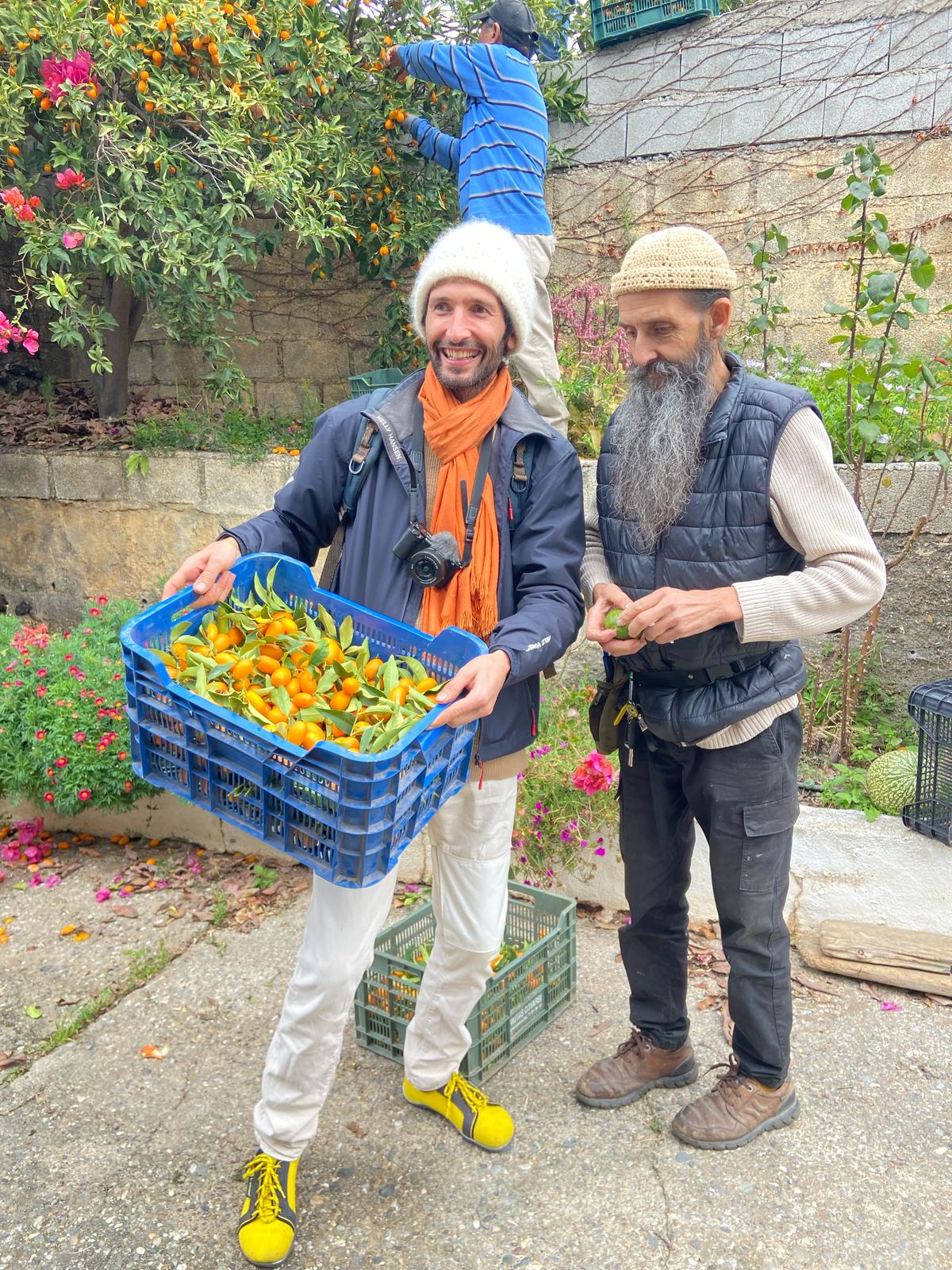
Le Végétalien
In the Fruitstock catalogue, there are organic products and natural ones. What does a certified organic product mean, and one that arrives marked CN, natural farming?
Rufino
“If a product is registered as organic, it can be called organic. At bottom, it is like a kind of registered trademark.”
Rufino
“There was a guy from Germany who worked in organic and who left it. We know he continues the same farming, but he no longer has the papers.”
Rufino
“And when someone is not certified but tells us: I cut the grass, I apply no products, then we make that distinction.”
Interview filmed by Virgile in Salobreña, 27 October 2024. Rufino speaks Spanish: we translate and tighten his answers, adding nothing.
In February 2025, in a citrus orchard, Rufino holds two big yellow pomelos. He picks up half a fruit from the ground and holds it out to the camera: the flesh is bright red. Further on, under an orange tree, a plastic bottle pierced with a tube hangs from a branch.
Rufino
“It is a Star Ruby pomelo. You recognise it by its red colour inside. It is in full season right now. At the beginning it is a little more acidic; now it has lost much of its acidity, and it is very pleasant to eat.”
Virgile
And do they keep easily? Are they firm?
Rufino
“Yes, yes. But that is how they are best: picked from the tree.”
Rufino
“That is a trap for the fruit fly, Ceratitis capitata. The fly goes in here, drawn by the smell.”
Virgile
Is it with sugar?
Rufino
“It is done in different ways. You can put in a little sugar, or something that smells strong. It goes in by the smell, and then it cannot find the way out. It is for the oranges: otherwise, it stings them.”
Scenes filmed by Virgile in orchards in Andalusia, February 2025. Words translated from Spanish.
Where it comes from
Andalusia — lemons from Granada and Málaga, Valencia Late oranges
The bitter orange tree is known by the Arabic name narany in al-Andalus; and azahar, orange blossom, comes from the Arabic zahr, “flowers”. The agronomists of al-Andalus described its cultivation and uses in detail. The lemon, the lime and the bitter orange are among the plants that came from distant regions, a major contribution of the Arabs.
Today, the lemon and orange trees of Andalusia are grown in several ways: organic, certified and inspected, or “natural farming”, a farming without inputs that carries no certification.
What it contains
Flavones, carotenoids and terpenes
A 2022 review describes the composition of citrus this way: polymethoxylated flavones, carotenoids, and the terpenes of the essential oil. Its abstract does not treat the peel separately.
A fragrant zest
The yellow of the peel carries the fragrance; the white beneath is bitter, so we do not grate it.
Very different fruits
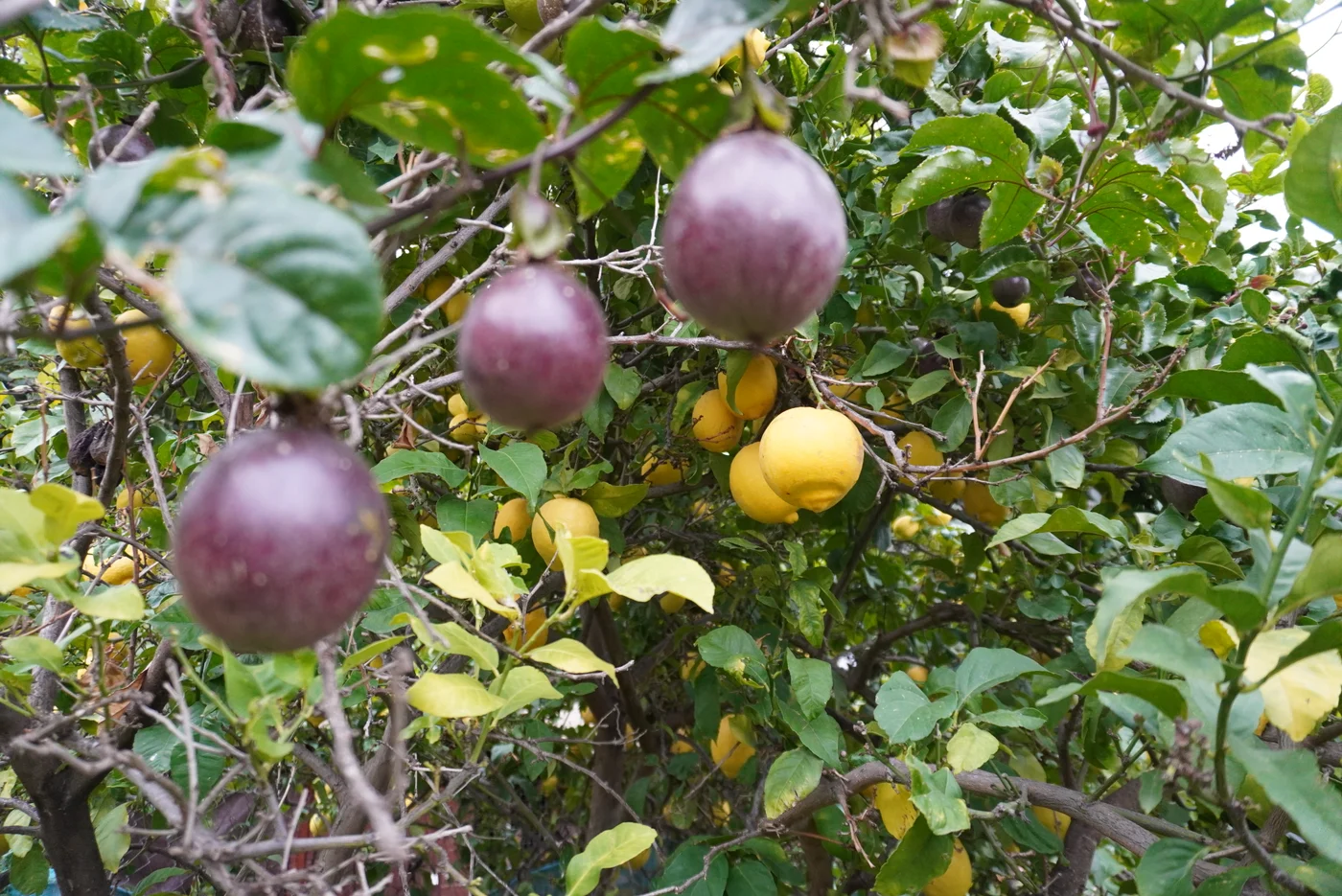
Lemon, redojo lemon, kagzi lime, finger lime (Citrus australasica), Valencia Late orange: each has its own season and its own way of being grown.
We did not collect a composition table for this sheet: no figure without a source we have read.
Cooking
- 1
Zest with a fine grater, down to the yellow, without the bitter white.
- 2
Rub the zest over a carrot salad or a fennel.
- 3
Bind lemon and zest into a tahini with a drizzle of olive oil.
Tradition, the people who make it, research
Three views we keep apart: what peoples have made of it, what we and our producers live with it, what studies have measured.
Tradition
The bitter orange tree is known by the Arabic name narany in al-Andalus; azahar, orange blossom, comes from the Arabic zahr, “flowers”. The agronomists of al-Andalus described its cultivation and uses in detail. The lemon, the lime and the bitter orange are among the plants that came from distant regions, a major contribution of the Arabs.
The people who make it
For Fruitstock, natural farming is farming “without inputs (without organic certification) that sees further”; organic is “the starting point and not an end in itself”.
Its summer 2026 catalogue lists the lemon in natural farming, from Granada and Málaga, the redojo lemon and the kagzi lime as organic, the finger lime in natural farming and organic, and the Valencia Late orange in natural farming, “15 months on the tree”. Since “natural farming” is not a certification, we ask the grower what the peel received after harvest.
What research says
What we know
The bitter orange tree is known by the Arabic name narany in al-Andalus, and azahar, orange blossom, comes from the Arabic zahr, “flowers”. The agronomists of al-Andalus described the cultivation and uses of the bitter orange tree in detail.
Tradition · 1Alhambra Patronato.The lemon, the lime and the bitter orange are among the plants that came from distant regions, a major contribution of the Arabs to the agriculture of al-Andalus.
Tradition · 1Legado Andalusí.For Fruitstock, natural farming is farming “without inputs (without organic certification) that sees further”; organic is “the starting point and not an end in itself”.
Researcher · 2Fruitstock. 2022Fruitstock's S36 catalogue lists the lemon in natural farming (Granada and Málaga), the redojo lemon and the kagzi lime as organic, the finger lime (Citrus australasica) in natural farming and organic, and the Valencia Late orange in natural farming, with the note “15 months on the tree”.
Researcher · 2Fruitstock. 2026Citrus fruits contain polymethoxylated flavones, carotenoids and the terpenes of the essential oil. The review's abstract does not treat the peel separately.
Study · 3Saini RK, Ranjit A, Sharma K et al. 2022In 2018, the European agency EFSA did not propose a residue limit for imazalil, a post-harvest treatment for citrus, as the toxicology of one of its metabolites was not settled.
Study · 3EFSA. 2018Post-harvest treatments on oranges, lemons and mandarins have had to appear on the label since 2011; in 2016, the Court of Justice of the European Union judged it reasonable to warn about them, since the peel is often eaten. Limes, pomelos and grapefruits are excluded.
Researcher · 2Que Choisir. 2016
What we don't know
What the peel of lemons grown in natural farming receives after harvest: we found no open page that says. We ask the grower.
What the composition of citrus changes for us: the review we read describes compounds, without treating the peel separately.
The film

Inside Fruitstock
Behind the scenes with its founders: an interview filmed by Le Végétalien.
Watch on YouTube
The questions people ask us
Can you eat the zest of a non-organic lemon?
Post-harvest treatments on oranges, lemons and mandarins have had to appear on the label since 2011; in 2016, the Court of Justice of the European Union judged it reasonable to warn about them, since the peel is often eaten. You read the label, or choose organic.
Natural farming or organic?
According to Fruitstock, organic is the starting point; natural farming goes “further”, without certification. It is not the same thing: organic is certified, natural farming rests on the grower's word, and you ask what the fruit received.
What does “Valencia Late” mean?
A late orange variety; Fruitstock notes “15 months on the tree” in its summer 2026 catalogue.
What is a finger lime, or caviar lime?
Citrus australasica, a citrus that Fruitstock offers in natural farming and organic.
Do limes fall under the labelling rule?
No: limes, pomelos and grapefruits are excluded.
Sources
Each source is ranked within a three-level ethical framework: documented tradition, recognised independent researcher, verified peer-reviewed study with no declared conflict of interest.
- Level 1
Alhambra Patronato. The bitter orange · Link
Page du patronat de l'Alhambra, lue : le bigaradier en al-Andalus, son nom arabe et celui de la fleur d'oranger.
- Level 1
Legado Andalusí. Orchards of Al-Andalus · Link
Article de magazine culturel, lu : les plantes venues de régions lointaines, apport des Arabes.
- Level 2
Fruitstock. Culture naturelle ou culture BIO ?, 2022 · Link
Page d'un producteur-distributeur, août 2022, lue : sa définition de la culture naturelle, rapportée comme sa parole.
- Level 2
Fruitstock. Catalogue S36 (2026), 2026 · Link
Catalogue d'un producteur-distributeur, lu : les agrumes proposés et leur mode de culture.
- Level 2
Que Choisir. L'Europe intraitable sur les agrumes traités, Que Choisir, 16/04/2016, 2016 · Link
Article d'une association de consommateurs, lu : l'étiquetage des traitements après récolte.
- Level 3
Saini RK, Ranjit A, Sharma K et al. Bioactive compounds of citrus fruits: a review of composition and health benefits of carotenoids, flavonoids, limonoids, and terpenes, Antioxidants 11(2): 239, 2022 · DOI: 10.3390/antiox11020239
Résumé lu via Europe PMC (PMID 35204122) : il n'aborde pas la peau à part.
- Level 3
EFSA. Updated review of the existing maximum residue levels for imazalil according to Article 12 of Regulation (EC) No 396/2005, EFSA Journal 16(10), 2018 · Link
Avis de l'agence européenne de sécurité des aliments, texte lu jusqu'au 100 000e caractère via Europe PMC (PMC7009713).
See also
Neighbours of this page
Updated on 22 November 2026
A mistake, something missing, a source to add? Write to us: every suggestion is read by us before it goes into the page.
What if, before buying a lemon, we asked what its peel has received?
Another question? The site is listening.