Mango from Andalusia
Why we chose it
Because a mango that has travelled a week rather than a month has a different aroma, and because the microclimate of the Costa Tropical offers it to us from late August to November. A grower from the Axarquía says that a Málaga fruit is picked about a week before it is eaten, against nearly 30 days for an overseas fruit. The season runs long enough to tune in to it: Osteen first, Keitt to finish.
Updated on 22 November 2026 · 7 sources · correct or complete
In one minute
The mango is the fruit of the mango tree, which comes from South Asia. Andalusia grows it on more than 5,000 hectares, mostly in Málaga: the harvest runs from August to November, with Osteen first, then the later Keitt. Most of these varieties, Osteen, Kent and Keitt, are picked green and ripen after picking; only Irwin, Maya and Ataulfo can ripen on the tree. To know if a mango is ripe, we trust touch, never colour: soft all over its surface, it is ready.
At Rufino's: the former mechanic and his mangoes
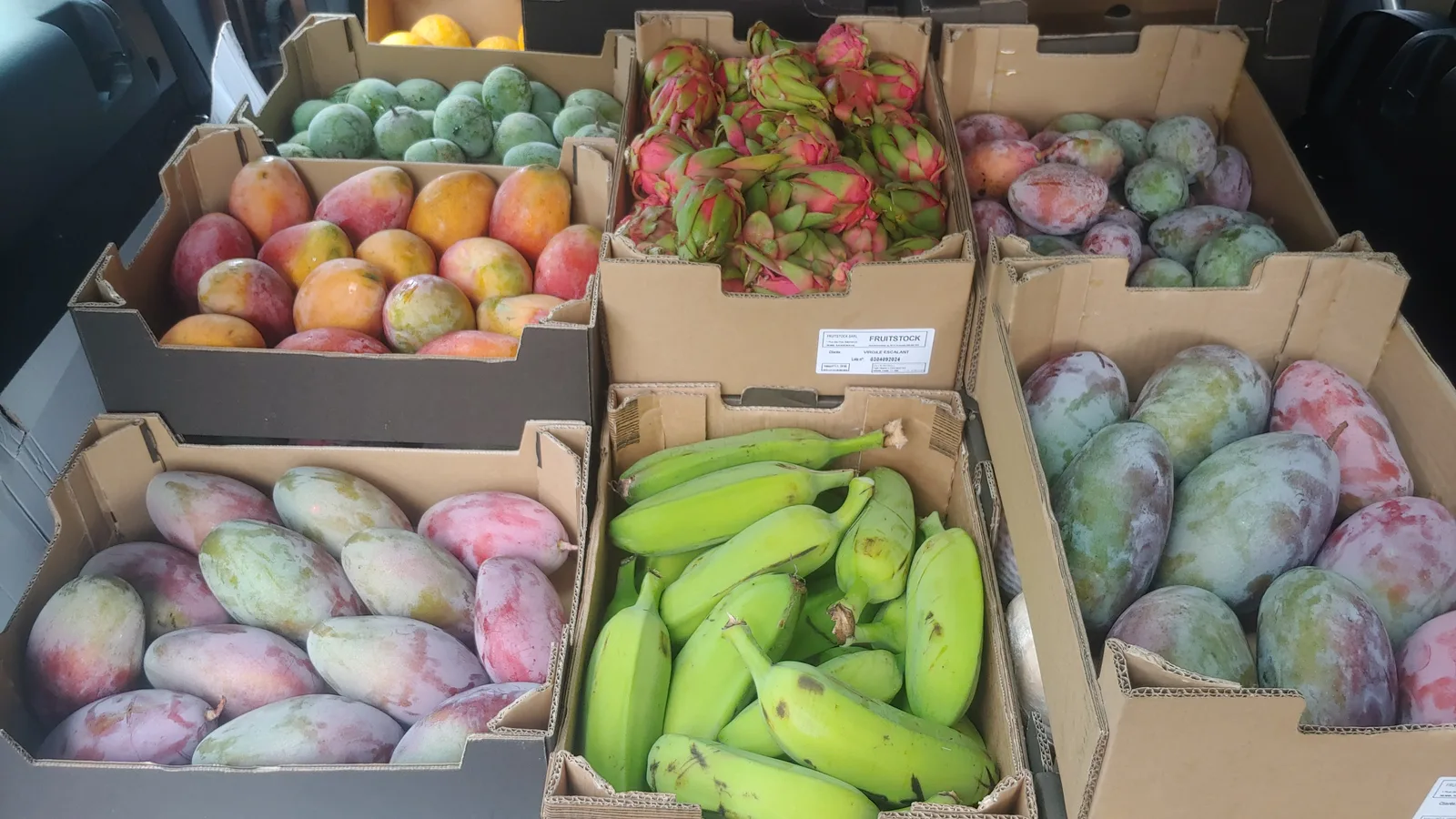
In Salobreña, on 27 October 2024, Virgile asks Rufino Ruiz Casado, Fruitstock's longtime producer, how he finds the people who grow for him. Rufino answers with an encounter: a man he first knew as a mechanic.
Le Végétalien
Sometimes friends who are in the same movement, the one around food, later become suppliers. Is that how it happens?
Rufino
“That happens too, but it is not the most common. Life goes like that, things come up when you are there.”
Rufino
“Last year, with the pitaya, I saw a man, the one who does it best. He has a lot of quality, because he also lets the mangoes take their colour. That, you have to know how to appreciate.”
Rufino
“I knew him as a mechanic. He stopped, he was almost at retirement age, and now he does this. It is fantastic, how well this man works. You can see he had wanted this for a long time.”
Rufino
“It is one of the values of this work: having found all these people, little by little. It is not easy.”
Interview filmed by Virgile in Salobreña, 27 October 2024. Rufino speaks Spanish: we translate and tighten his answers, adding nothing.
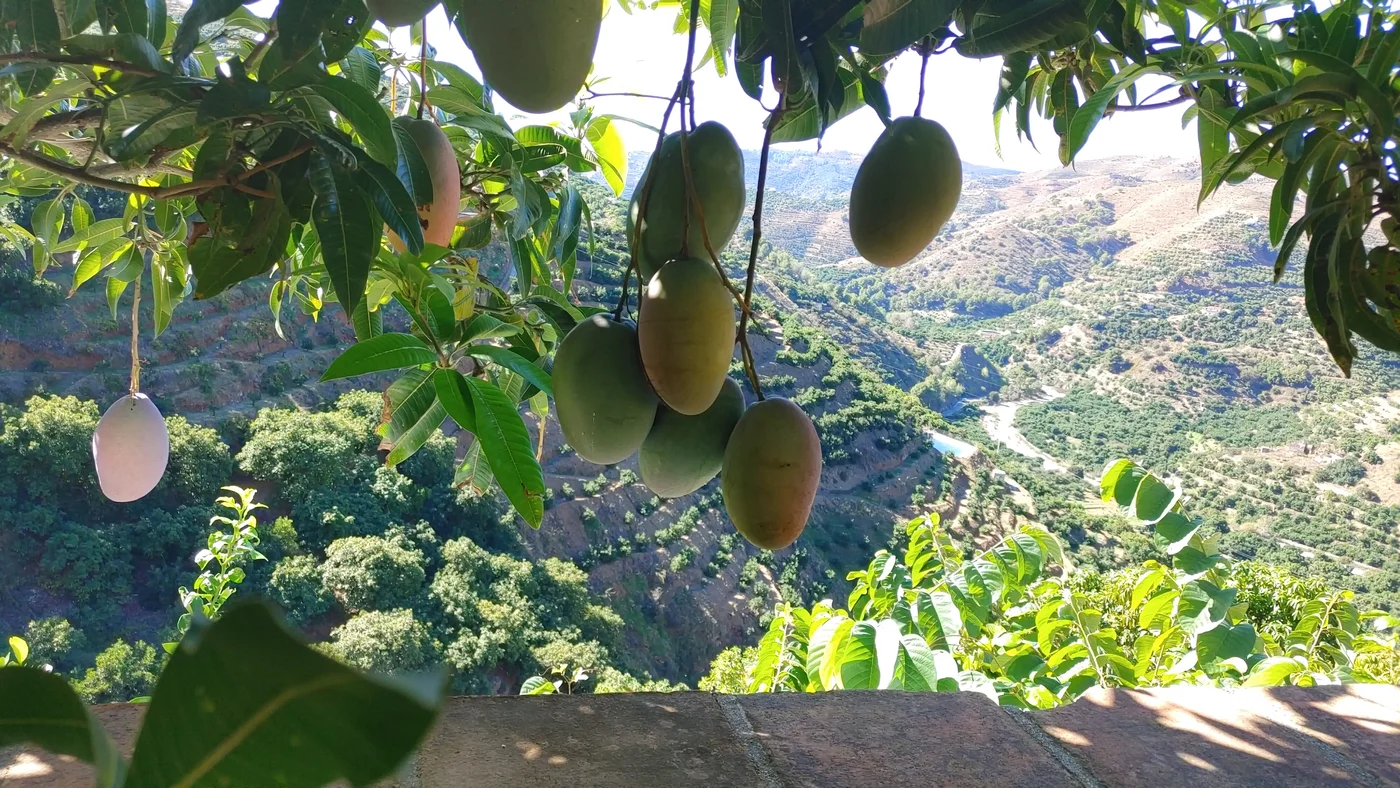
In February 2025, on a tree-lined path, Rufino picks two leaves and lays them side by side in his hand: one from a mango tree, one from an avocado tree. In an orchard on a slope, a small knife and a wedge of citrus between his fingers, he answers a question from Virgile.
Rufino
“The mango leaf and the avocado leaf are very, very different. When it is a little like this, it is the avocado tree. When you see a point, like this, it is the mango tree.”
Virgile
Rufino, you have lived with fruit all your life, on magnificent farms. Which ones do you prefer, and eat every day?
Rufino
“It depends on the season, I change as I go. Right now, passion fruit, cherimoya, avocados. Citrus too: pomelo, orange, mandarin. Then come loquats, cherries, melon, watermelon. In summer, pitaya. Then mangoes, cherimoya.”
Rufino
“But let us say that avocado, mango and cherimoya are almost the fundamentals. Ah, and papaya! Papaya, lately, a lot, a lot.”
Scenes filmed by Virgile in orchards in Andalusia, February 2025. Words translated from Spanish.
Where it comes from
South Asia — grown in Andalusia, mostly in Málaga
The mango tree comes from the area between the north-east of the Indian subcontinent and Burma. It has been grown in South and Southeast Asia since antiquity: the edicts of Emperor Ashoka mention the planting of mango groves. This origin is reported from an online encyclopedia, for lack of a primary source we could open.
In Andalusia, the mango tree has settled on the coast, between Málaga and Granada, where the climate allows it: more than 5,000 hectares, mostly in Málaga, the rest in Granada.
What it contains
A pulp rich in carotenoids
In a 2026 study, the flours made from mango pulp contained more carotenoids than the others.
A peel and a stone rich in flavonols
In the same study, the peel and stone flours contained more flavonols. We are observing a composition, not an effect.
Very different varieties
Osteen, Keitt, Kent, Irwin, Ataulfo: each has its own cycle and its own way of ripening.
We did not collect a composition table for this sheet: no figure without a source we have read.
Cooking
- 1
Trust touch, never colour: soft all over its surface, it is ready.
- 2
Ripen it in the warmest, driest room; kept cool, before it is fully ripe, we count about 15 days.
- 3
Too ripe: dehydrate it, make a compote, or freeze it for ice creams and smoothies.
- 4
Some varieties, like Irwin or Madame Francis, need to be kept cool as soon as they are barely soft.
Tradition, the people who make it, research
Three views we keep apart: what peoples have made of it, what we and our producers live with it, what studies have measured.
Tradition
The mango tree comes from the area between the north-east of the Indian subcontinent and Burma, and has been grown in South and Southeast Asia since antiquity: the edicts of Emperor Ashoka mention the planting of mango groves. We read it in an online encyclopedia, not in a primary source.
The people who make it
Andalusia has more than 5,000 hectares of mango trees, mostly in Málaga, the rest in Granada; the harvest runs from August to November. Osteen, the most widely grown, is picked from mid-September to October; Keitt, second, is late; Kent has an intermediate cycle. These three are harvested green and ripen after picking; only Irwin, Maya and Ataulfo can ripen on the tree. A grower from the Axarquía explained in 2021 that the season starts in late August with Tommy Atkins, that Osteen lasts until late October and Keitt until mid or late November.
Fruitstock grows more than 30 varieties of mango, sold from late August to late December; its summer 2026 catalogue offers Ataulfo, Bandai, Dusheri, Haden, Irwin, Kent, Osteen and Zill, from Granada or Málaga.
What research says
What we know
The mango tree comes from the area between the north-east of the Indian subcontinent and Burma; it has been grown in South and Southeast Asia since antiquity, and the edicts of Emperor Ashoka mention the planting of mango groves.
Tradition · 1Wikipedia.Andalusia has more than 5,000 hectares of mango trees, mostly in Málaga, the rest in Granada; the harvest runs from August to November. Osteen, the most widely grown, is picked from mid-September to October; Keitt, second, is late; Kent has an intermediate cycle. These three are harvested green and ripen after picking; only Irwin, Maya and Ataulfo can ripen on the tree.
Researcher · 2Agronews Castilla y León.For a grower from the Axarquía, in 2021, the season starts in late August with Tommy Atkins, Osteen lasts until late October, Keitt until mid or late November; a Málaga fruit is picked about a week before it is eaten, against nearly 30 days for an overseas fruit.
Researcher · 2Freshplaza, Axarquía Tropical. 2021Fruitstock grows more than 30 varieties of mango, sold from late August to late December.
Researcher · 2Fruitstock.Fruitstock's S36 catalogue offers the mangoes Ataulfo, Bandai, Dusheri, Haden, Irwin, Kent, Osteen and Zill, from Granada or Málaga; some varieties (Irwin, Madame Francis) need to be kept cool as soon as they are barely soft.
Researcher · 2Fruitstock. 2026For Fruitstock, a mango is judged by touch rather than colour: soft all over its surface, it is ready. Before it is fully ripe, it keeps about 15 days in the cool; too ripe, you dehydrate it, make a compote or freeze it.
Researcher · 2Fruitstock.In a study of cakes where 35% of the wheat flour was replaced by five mango flours, those made from pulp contained more carotenoids, those from peel and stone more flavonols.
Study · 3Lobo FA, Stinco CM, Benítez-González AM, Hernanz D, Jara-Palacios MJ. 2026
What we don't know
The exact age of our press sources on Andalusian varieties: one dates from 2021, the other is undated, and the surface figures may have moved since.
What the composition of the mango changes for us: the research we can reach is thin, and what we have read describes flours in cakes, not the fruit as eaten. A fuller review remains to be found.
The film

Inside Fruitstock
Behind the scenes with its founders: an interview filmed by Le Végétalien.
Watch on YouTube
The questions people ask us
What is the mango season in Spain?
From late August to November in the Axarquía and on the Costa Tropical; Fruitstock sells its own until late December.
Which variety is the most widely grown?
Osteen, ahead of Keitt.
How can you tell if a mango is ripe?
By touch: it is soft all over its surface. Colour tells you nothing.
Can you keep it in the fridge?
Before it is fully ripe, about 15 days, according to Fruitstock. Some varieties, like Irwin or Madame Francis, need to be kept cool as soon as they are barely soft.
What does “gourmet” mean?
At Fruitstock: a small size, first flowerings, a reduced stone.
Sources
Each source is ranked within a three-level ethical framework: documented tradition, recognised independent researcher, verified peer-reviewed study with no declared conflict of interest.
- Level 1
Wikipedia. Mango · Link
Encyclopédie en ligne, pas une source primaire : l'origine et l'ancienneté de la culture du manguier sont rapportées d'après elle, page lue.
- Level 2
Agronews Castilla y León. Principales variedades de mango en Andalucía · Link
Article de presse agricole, page lue ; sans date lue.
- Level 2
Freshplaza, Axarquía Tropical. Starting this week, everyone will have mangoes as a seasonal fruit on the shelves, Freshplaza, 15/09/2021, 2021 · Link
Article de presse professionnelle de 2021, lu : propos d'un producteur de l'Axarquía sur la saison et le trajet du fruit.
- Level 2
Fruitstock. Qui est Rufino ? · Link
Page d'un producteur-distributeur, lue : c'est sa parole, rapportée comme telle.
- Level 2
Fruitstock. Catalogue S36 (2026), 2026 · Link
Catalogue d'un producteur-distributeur, pages 3 à 5 lues : les variétés de mangue proposées et leurs conseils de garde.
- Level 2
Fruitstock. Nos mangues · Link
Page d'un producteur-distributeur, lue : conseils de maturation et de garde.
- Level 3
Lobo FA, Stinco CM, Benítez-González AM, Hernanz D, Jara-Palacios MJ. Upcycling of Mango Pulp and By-Products into Functional Flours: Effects on Bioactive Composition and Bioaccessibility in Cupcakes, Foods 15(19), 2026 · DOI: 10.3390/foods15193527
Résumé lu via Europe PMC (PMID 42883634) : cinq farines de mangue remplacent 35 % de la farine de blé de gâteaux.
See also
Neighbours of this page
Updated on 22 November 2026
A mistake, something missing, a source to add? Write to us: every suggestion is read by us before it goes into the page.
What if the best mango of the year were the one that travelled only a week?
Another question? The site is listening.