Avocado from Andalusia
Why we chose it
Because a ripe avocado is a plant butter you can cut with a spoon, and because the avocado tree grows in the south of Spain, between Málaga and Granada. The avocado is one of the few fatty fruits, with coconut and olive. Its harvest follows a precise calendar: Bacon in autumn, Fuerte in winter, Hass from winter into spring.
Updated on 22 November 2026 · 7 sources · correct or complete
In one minute
The avocado is the fruit of the avocado tree, which comes from the forests of Central America. It is a fatty fruit, like coconut and olive: ripe, its flesh can be cut with a spoon. In Andalusia, plantations cover more than 13,000 hectares between Málaga and Granada, more than 80% of them Hass. The season changes with the variety: Bacon from October to December, Fuerte from November to February, Hass from December to April. We press it gently in the palm to know if it is ripe, and let it ripen on the kitchen counter, never in the fridge while it is still hard.
At Rufino's in Salobreña: the grass we cut
On 27 October 2024, Virgile sits down in the office of Rufino Ruiz Casado, in Salobreña, on the Granada coast. Rufino is Fruitstock's longtime producer, and he knows most of the farms our avocados come from. The camera rolls, an interpreter translates, and the conversation quickly turns to what happens before the picking: the soil.
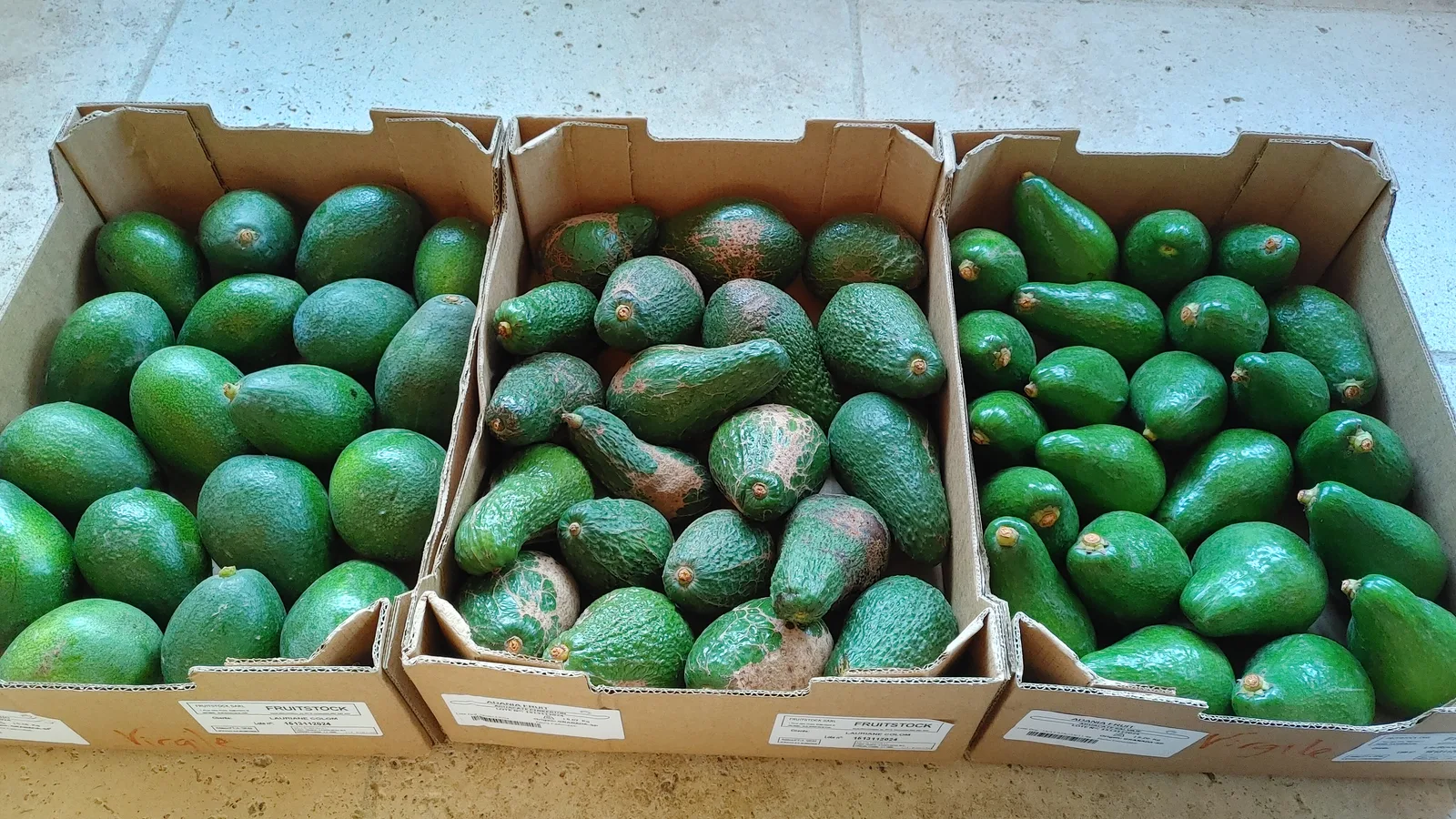
Rufino
“In general, I know the farms. Not all of them, but I know them. And what matters is that they use no herbicide there. For avocado and cherimoya, it is one of the things that make the difference.”
Rufino
“Many people farm almost as if it were organic. I tell them: look, you put on manure, you cut the grass, you use no herbicide. You are one step away from getting it certified.”
Rufino
“It is not like apples, which need more treatments. Cherimoya and avocado, so far, have almost no pest problems.”
Le Végétalien
And why don't these growers get certified? Is it because it costs money?
Rufino
“It costs money, and there is a whole follow-up: the invoices, what was bought, what was applied, who it was sold to. Every visit is paid for, every leaf or soil analysis is paid for. You can raise the selling price a little, but it does not make up for all those costs.”
Interview filmed by Virgile in Salobreña, 27 October 2024. Rufino speaks Spanish: we translate and tighten his answers, adding nothing.
In February 2025, we come back with the Fruitstock team. In an orchard, two pickers pull Reed avocados off the trees, one by hand with pruning shears, the other at the end of a long reed pole. In front of the pile of crates, Rufino takes two, nice and round, and turns them in his palms.
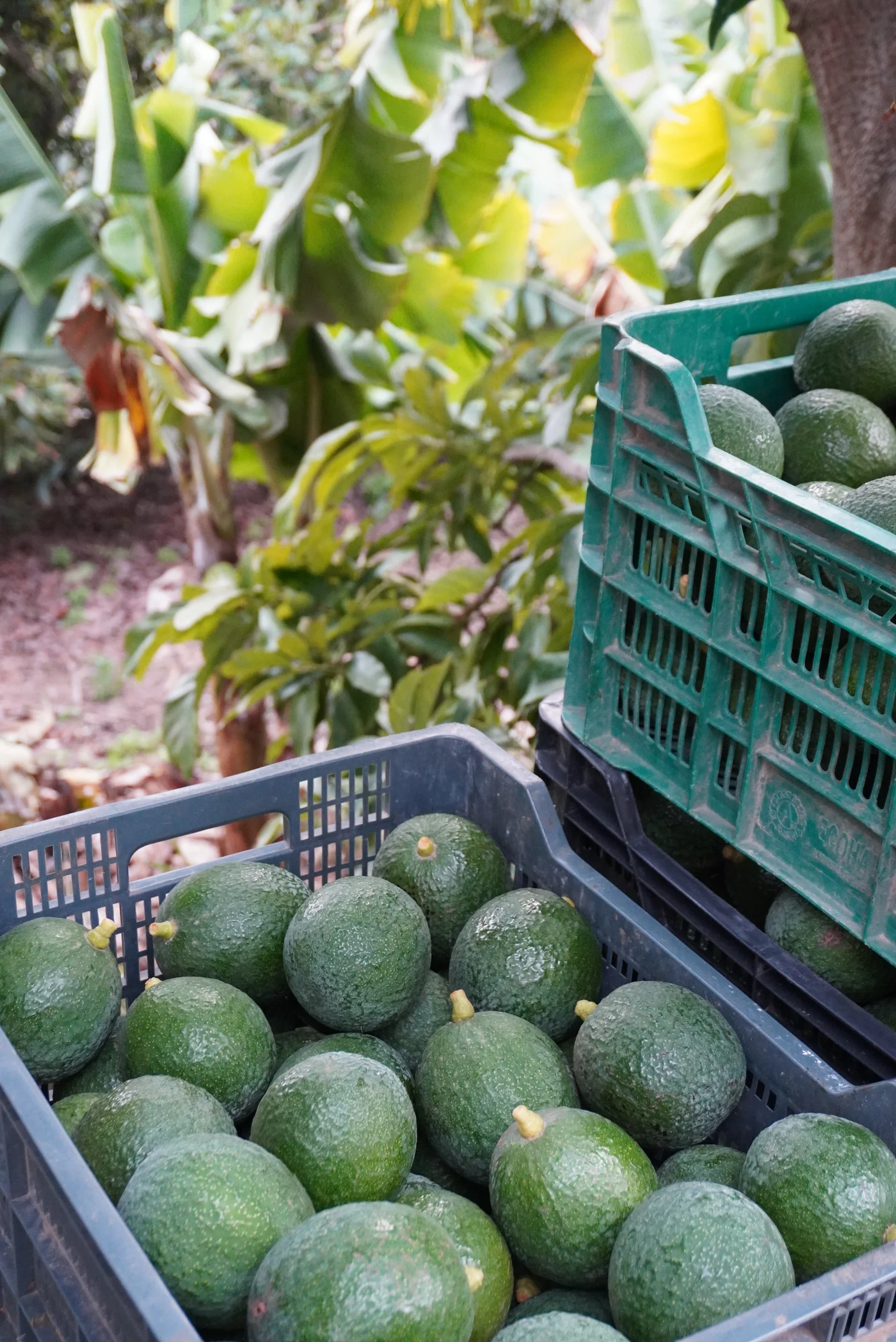
Rufino
“Here we are picking the Reed avocado, with this slightly rounded shape. Its season is just beginning. To my taste, it is from July that it is very good: June, July, August, September. Now it is starting, but it is not yet a hundred percent.”
Virgile
Which varieties do you prefer?
Rufino
“For me, Bacon. When there is Bacon, I think it is the best.”
Virgile
And why, in France, do we know almost only Hass?
Rufino
“Because it has better qualities for the market. A survey was done in California when this variety was created: women preferred Hass because it changed colour, and you knew when it was ripe. And its skin is stronger, a little tougher than that of Bacon and Fuerte.”
Rufino
“But for me, it is not the best. Hass is very good, but when it has stayed on the tree a long time. At the beginning, it is so-so.”
Scenes filmed by Virgile in orchards in Andalusia, February 2025. Words translated from Spanish.
Where it comes from
Forests of Central America — grown in Andalusia, between Málaga and Granada
The avocado tree comes from the heavily watered forests of Central America. Three races are distinguished, Mexican, Guatemalan and West Indian; most of the varieties grown in the Mediterranean are Mexican-Guatemalan hybrids. Fuerte, for example, was collected in Puebla, Mexico, in 1911.
In Andalusia, the tree has settled between Málaga and Granada: more than 13,000 hectares, about 8,000 in Málaga and 3,000 in Granada, more than 80% of them planted with Hass.
What it contains
A fatty fruit
Its melting flesh is made mostly of fat: this is what makes it creamy, and what the authors of the 2005 study point to in explaining what happens to the carotenoids of a meal.
Varieties that take turns
Bacon from October to December, Fuerte from November to February, Hass from December to April: Spanish avocado can be found all winter long.
A fruit that ripens at home
It softens on the counter; ripe, it gives under the palm.
We did not collect a composition table for this sheet: no figure without a source we have read.
Cooking
- 1
To choose: press it in the palm, not with the fingertips, and avoid soft pockets.
- 2
To ripen: on the counter, with an apple or a kiwi in a paper bag to speed things up.
- 3
A fruit that is still hard does not go in the fridge; ripe, it keeps for up to a week.
- 4
Once cut: a squeeze of lemon over the flesh, tight cling film with no air, in the fridge.
Tradition, the people who make it, research
Three views we keep apart: what peoples have made of it, what we and our producers live with it, what studies have measured.
Tradition
The avocado tree comes from the heavily watered forests of Central America. Three races have been distinguished there, Mexican, Guatemalan and West Indian, and Fuerte, one of the varieties that travelled to the Mediterranean, was collected in Puebla, Mexico, in 1911.
The people who make it
On the Costa Tropical, Rufino Ruiz Casado grows more than a dozen varieties of avocado and keeps “2 or 3” of them all year round. Fruitstock presents Bacon, Reed, Hass and Lamb Hass.
Andalusia has more than 13,000 hectares of avocado trees, about 8,000 in Málaga and 3,000 in Granada, more than 80% of them Hass.
What research says
What we know
The avocado tree is native to the heavily watered forests of Central America.
Study · 3IFAPA, Junta de Andalucía.Three races of avocado tree are distinguished, Mexican, Guatemalan and West Indian; most Mediterranean varieties are Mexican-Guatemalan hybrids, and Fuerte was collected in Puebla, Mexico, in 1911.
Researcher · 2Hormaza I. (IHSM-UMA-CSIC). 2021Andalusia has more than 13,000 hectares of avocado trees (about 8,000 in Málaga and 3,000 in Granada), more than 80% of them Hass. Bacon is harvested from October to December, Fuerte from November to February, Hass from December to April.
Researcher · 2Hormaza I. (IHSM-UMA-CSIC). 2021On the Costa Tropical, Rufino Ruiz Casado grows more than a dozen varieties of avocado and keeps “2 or 3” of them all year round.
Researcher · 2Fruitstock.Fruitstock presents four varieties: Bacon, Reed, Hass and Lamb Hass.
Researcher · 2Fruitstock.In two small studies of eleven people each, 150 g of avocado in a salsa multiplied the lycopene measured in the blood by 4.4 and the beta-carotene by 2.6, compared with the salsa alone; in a salad, by 5.1 to 15.3 times. The authors link the effect mainly to the avocado's fat.
Study · 3Unlu NZ, Bohn T, Clinton SK, Schwartz SJ. 2005To ripen, an avocado is left on the counter; in a paper bag with an apple or a kiwi, it ripens faster. No oven, no microwave: the fruit softens without ripening.
Researcher · 2California Avocado Commission.An avocado that is still hard does not go in the fridge; ripe, it keeps for up to a week. Once cut, it is kept with lemon juice pressed over the flesh, under tight cling film with no air, in the fridge.
Researcher · 2California Avocado Commission.
What we don't know
What other meals, other amounts or other people would give: the 2005 study has only eleven volunteers in each of its two parts, and it measures carotenoids in the blood, not an effect on health.
How long the peoples of Central America have cultivated the avocado tree: we found no open page that dates it.
The film

Inside Fruitstock
Behind the scenes with its founders: an interview filmed by Le Végétalien.
Watch on YouTube
The questions people ask us
How can you tell if an avocado is ripe?
Press it gently with the palm of your hand, not with your fingertips: it should give a little, with no soft pocket.
How do you ripen an avocado fast?
In a paper bag, with an apple or a kiwi. No oven, no microwave: the fruit softens without ripening.
What is the avocado season in Spain?
It depends on the variety: Bacon is harvested from October to December, Fuerte from November to February, Hass from December to April.
How do you keep half an avocado?
Squeeze lemon over the flesh, press cling film tight against it with no air, and keep it in the fridge.
Which avocado varieties are grown in Spain?
Mostly Hass, which makes up more than 80% of Andalusia's plantations, then Bacon and Fuerte, which extend the season. Fruitstock presents Bacon, Reed, Hass and Lamb Hass.
Sources
Each source is ranked within a three-level ethical framework: documented tradition, recognised independent researcher, verified peer-reviewed study with no declared conflict of interest.
- Level 2
Hormaza I. (IHSM-UMA-CSIC). La diversidad infrautilizada del aguacate, Interempresas, 16/09/2021, 2021 · Link
Article d'un chercheur du CSIC, page lue : les trois races, la Fuerte, les variétés, le calendrier de récolte et les surfaces d'Andalousie.
- Level 2
Fruitstock. Qui est Rufino ? · Link
Page d'un producteur-distributeur, lue : c'est sa parole, rapportée comme telle.
- Level 2
Fruitstock. Nos avocats · Link
Page d'un producteur-distributeur, lue : les variétés qu'il propose.
- Level 2
California Avocado Commission. How to ripen an avocado · Link
Conseils d'une interprofession de producteurs, page lue.
- Level 2
California Avocado Commission. How to store avocados · Link
Conseils d'une interprofession de producteurs, page lue.
- Level 3
IFAPA, Junta de Andalucía. Recomendaciones para reducir el impacto de la sequía en aguacate · Link
Document de l'institut de recherche agricole d'Andalousie, pages 1 à 8 lues ; date non lue. Cité seulement pour l'origine de l'avocatier.
- Level 3
Unlu NZ, Bohn T, Clinton SK, Schwartz SJ. Carotenoid absorption from salad and salsa by humans is enhanced by the addition of avocado or avocado oil, The Journal of Nutrition 135(3): 431-436, 2005 · DOI: 10.1093/jn/135.3.431
Résumé lu via Europe PMC : deux petites études de onze personnes chacune.
See also
Neighbours of this page
Updated on 22 November 2026
A mistake, something missing, a source to add? Write to us: every suggestion is read by us before it goes into the page.
What if we learned to tell an avocado's variety, the way we tell an apple's?
Another question? The site is listening.