

Plant Proteins: The Alchemy of the Living
You've been asked a thousand times: "where do you get your protein?". This article won't give you yet another table. It takes you on a journey through DNA, biophotons and the intelligence of the living — to finally understand why the plant kingdom isn't a second-rate alternative, but the primary source.
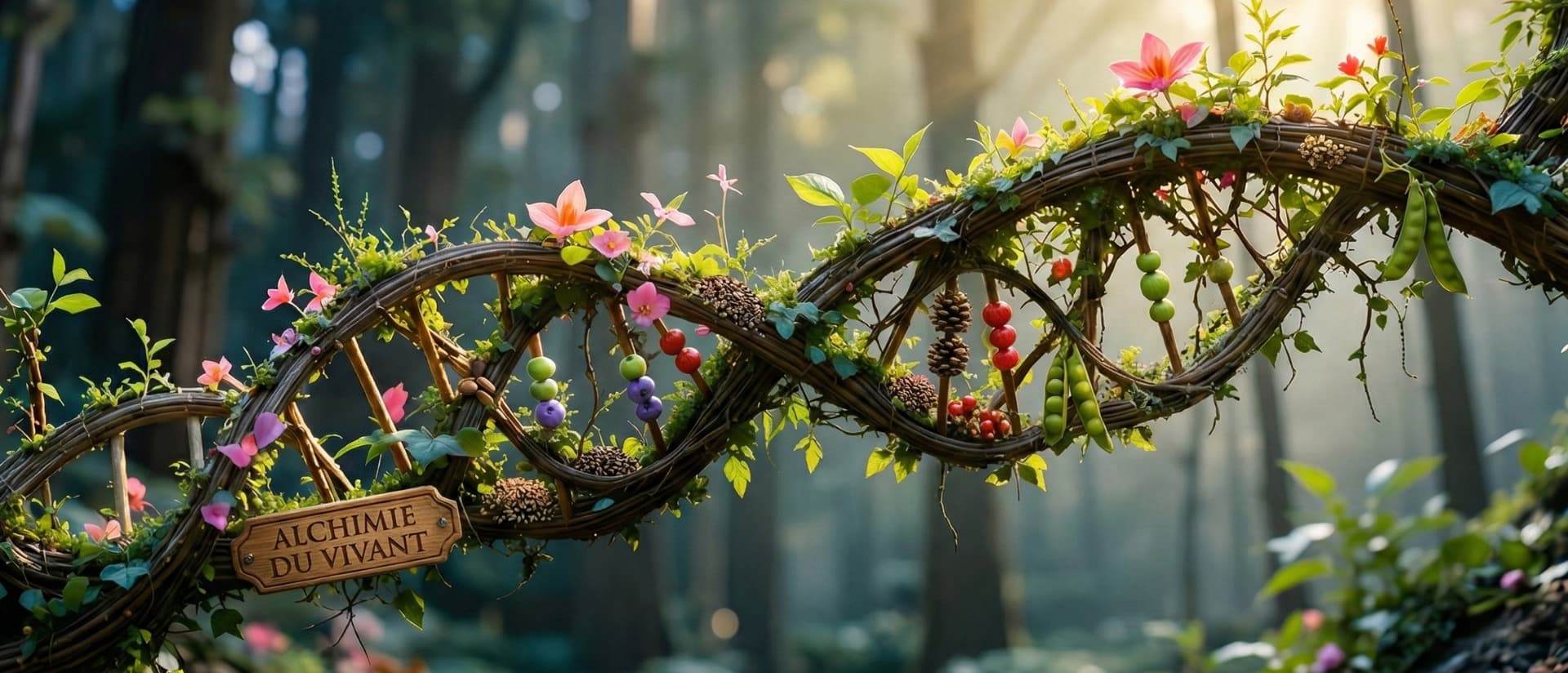
You've been asked the same question a thousand times. "But where do you get your protein?" — as if the plant world were a nutritional desert and a rib-eye steak were the only passport to health.
This question, as irritating as it is, deserves to be explored — but not the way it usually is. Not with a simple comparative table of grams per serving. What I offer here is a journey into a deeper understanding of what proteins truly are, why they are so fundamental, and how the plant kingdom offers a path of elegance that the animal world cannot match.
Because the real question isn't where to find protein. It's which proteins to choose — and why the vibrational quality of their source changes everything.
Proteins are the life forms generated by DNA
Let's start at the beginning. With something that should fill us with wonder, and that we forget too often.
Your DNA — that double helix coiled within the nucleus of each of your 37 trillion cells — contains about 2% of so-called "coding" sequences. That 2% is the source code for proteins. Out of the 3.2 billion letters of your genome, a minute fraction carries the instructions for manufacturing the molecular machines that do everything in your body.
The enzymes that digest your meal? Proteins. The collagen that structures your skin? A protein. The haemoglobin that carries oxygen through your blood? A protein. The receptors that let your neurons communicate? Proteins. The antibodies that defend you? Proteins.
If we unrolled the DNA contained in your body, it would stretch out over 10 billion kilometres — 67 times the Earth–Sun distance. This genetic library holds the instructions to build and maintain an organism of a complexity that surpasses anything humanity has ever designed. And its main production, its opus magnum, is proteins.
When you eat, you provide this library with the raw materials — amino acids — it needs to express its code. It's an act of permanent creation. Your gastric mucosa renews itself every 3 to 5 days. Your skin every 28 days. Your red blood cells every 120 days. Your skeleton restructures itself entirely in 10 years. In 7 years, nearly all your atoms will have been replaced.
The question then becomes vertiginous: with what materials do you choose to rebuild your temple?
The 20 bricks — or the alphabet of life
Proteins are chains of amino acids — 20 in total. Twenty letters to write every possible protein. Like an alphabet capable of producing the poetry of Rumi just as well as the equations of Planck.
Out of these 20, your body can synthesise 11 on its own. The other 9 must come from food — these are called essential. Not because the others aren't, but because your body doesn't know how to make them. Their absence compromises the build.
These 9 essentials are: leucine, isoleucine, valine (the famous BCAAs — branched-chain amino acids), lysine, methionine, phenylalanine, threonine, tryptophan, and histidine.
This is where the debate between animal and plant proteins begins — and where it deserves to be raised.
The myth of the "complete" protein
You're told an animal protein is "complete" because it contains all 9 essential amino acids in sufficient proportions. That's true. A steak, an egg, a fish — each contains all 20 amino acids in a single food.
You're then told that plant proteins are "incomplete" — that they always lack one or two essential amino acids. This is partially true, but the conclusion drawn from it is profoundly false.
Because here's what goes unsaid: no human being eats a single food. You don't live on rice alone, or lentils alone. The natural combination of plant foods creates complete amino acid profiles — and often superior ones in terms of what accompanies them.
Grains are poor in lysine, rich in methionine. Legumes are the exact opposite: rich in lysine, poor in methionine. A dish of rice and lentils? Complete amino acid profile. This is what ancient civilisations practised intuitively for millennia: dal and rice in India, black beans and corn in Mexico, couscous and chickpeas in the Maghreb.
And today, nutritional science confirms what our ancestors knew: it isn't even necessary to combine these foods in the same meal. Your body maintains a "pool" of amino acids it continuously draws from. A varied diet over the day is enough.
Plant sources — a distributed intelligence
Unlike meat, which concentrates its proteins in the muscle fibre of a dead animal, plant proteins are distributed across a living ecosystem of complementary sources. And this distribution is their strength.
Hemp — the complete architect
Hemp is a remarkable exception: complete amino acid profile, 33% protein, rich in magnesium and omega-3. Hemp requires no combination. Alone, it suffices. Its main protein — edestin — is structurally close to the proteins of human blood plasma, which makes it one of the most assimilable in the plant kingdom. Add to that its ability to grow without pesticides, to regenerate soils, and you may be looking at the most intelligent food on the planet.
Spirulina — the cosmic ancestor
This cyanobacterium, 3.5 billion years old — one of the first living organisms on the planet — contains 60 to 70% complete protein, with all essential amino acids present. On top of that, it provides bioavailable iron and, above all, phycocyanin — that celestial-blue antioxidant that specifically protects your mitochondria, the energy plants of your cells.
Eating spirulina means feeding on an organism that has survived every mass extinction. It's integrating 3.5 billion years of resilience. But watch the quality: raw spirulina, dried at low temperature (below 42°C), retains its enzymes and its intense blue-green colour. Industrial, heat-processed spirulina is green, bitter — informationally impoverished.
Vibrational scale — Spirulina
Unités Bovis (UB)
L'échelle de Bovis mesure la vitalité énergétique d'un aliment — plus le chiffre est élevé, plus l'aliment soutient la vitalité du corps. Indicatif, pas dogmatique.
Enzymes destroyed, green colour, bitterness. Partial nutritional contribution.
Phycocyanin intact, intense blue-green, biophotons preserved. Complete living information.
The drying temperature determines the informational quality of spirulina. Above 42°C, enzymes and phycocyanin progressively degrade.
Legumes — the ancestral foundation
Lentils, chickpeas, mung beans, fava beans — legumes have been humanity's protein foundation for 10,000 years. The mung bean (moong dal), for example, is considered in Ayurveda the most cooling, most easily digestible, and most sattvic legume — the one that promotes mental clarity and inner calm.
Seeds and nuts — cofactors embodied
Pistachios, almonds, pumpkin seeds, chia seeds — each brings not only protein but precious cofactors that amplify assimilation. Pumpkin seeds are one of the best sources of plant zinc. Almonds provide calcium. Tahini (sesame) combines calcium, magnesium, and protective lignans. Nature never separates proteins from their partners. Industry does.
Pea protein — gentle efficiency
Dense, gentle on the gut, with excellent leucine content — the key amino acid for muscle synthesis — pea protein is one of the best tolerated. Its digestibility is higher than that of many animal proteins. It rarely triggers intolerances. It's a base I use in my nootropic formulations precisely for this gentleness: it provides structure without aggression.
The vibrational dimension — why the source changes everything
This is where my vision diverges from conventional nutrition. And where I invite you to consider proteins not only as assemblies of molecules, but as carriers of information.
Foods carry a memory
An adaptogenic plant like rhodiola has survived millions of years under the extreme conditions of the Arctic. It carries the memory of that resilience within it — and when you ingest it, that information dialogues with your cells, stimulating your own stress-adaptation mechanisms.
An industrial farm animal, confined, stressed, fed processed food and slaughtered in fear — what vibrational information does it carry? What message do its proteins transmit to your cells?
Conversely, a hemp seed germinated in the sun, a spirulina grown in pure water under open sky, a pea that grew in rotation with complementary crops — these foods carry a quality of life, a coherence, an intact information.
Biophotons — light on your plate
The work of biophysicist Fritz-Albert Popp has shown that every living cell emits biophotons — ultra-weak, coherent particles of light that coordinate cellular communication. At least 75% of this biophotonic activity comes from DNA itself.
When you eat a raw, living food, you absorb not only its chemical nutrients but its luminous information. A food cooked at high temperature, processed, irradiated — has lost this photonic dimension. It remains "nutritious" in the biochemical sense, but it is informationally impoverished.
It's the difference between receiving a handwritten letter and receiving a blurry photocopy of that letter. The semantic content is similar, but the complete information no longer comes through.
Raw or lightly cooked plant proteins — hemp, spirulina, sprouted seeds, shoots — preserve this biophotonic quality that high-temperature cooked animal proteins have lost forever.
Vibrational scale — Protein sources
Unités Bovis (UB)
L'échelle de Bovis mesure la vitalité énergétique d'un aliment — plus le chiffre est élevé, plus l'aliment soutient la vitalité du corps. Indicatif, pas dogmatique.
Stressed animal, proteins denatured by high cooking, no residual enzymatic activity.
Amino acid profile present but decontextualised. No living cofactor.
Proteins partially preserved, fibres intact, mineral cofactors present.
Active fermentation, living enzymes, amino acid profile amplified by micro-organisms.
Complete amino acid profile, omega-3, magnesium. Living information intact.
3.5 billion years of resilience. Complete proteins, phycocyanin, biophotons.
The vibrational scale doesn't replace nutritional analysis — it complements it. Two foods with the same amino acid profile can carry radically different informational qualities.
Keto plant-based — the path of precision
There's a common belief that a high-fat diet is incompatible with plant-based eating. It's false — but it demands mastery.
The classic ketogenic diet leans heavily on animal proteins and fats because it's mechanically easier. Plant-based keto demands an alchemist's approach: combine, balance, synergise. Animal keto is "robust" — hard to miss nutritionally. Plant-based keto is "precise" — beautiful when done right.
Compatible protein sources: hemp (33% protein, 9% net carbs — the champion), firm tofu (2–3 g net carbs), tempeh (fermented, therefore more bioavailable), and lupin — still too little known — which offers 40% protein with near-zero net carbs. On the noble fat side: coconut oil and MCT, avocado and olives, macadamia and Brazil nuts (the queens of keto with 75% and 67% lipids).
Metabolic breathing
Rather than a rigid keto, I propose a cyclical approach I call metabolic breathing: a few days low-carb (leafy greens, avocados, coconut, hemp, nootropic bars), then a day with more fruits and root vegetables to reload glycogen and nourish the microbiome.
Inhale: fats, light ketosis. Exhale: living glucose, gentle glycolysis.
This metabolic flexibility — the body's ability to navigate smoothly between the two energy pathways — is the sign of a truly healthy organism. Stable energy even when skipping a meal. No crash after fruit. Constant mental clarity.
Cofactors — what proteins don't do alone
Here's what nutrition tables never say: a protein without its cofactors is like a piano without a pianist. Amino acids need partners to be properly assimilated and used by your body.
Magnesium, involved in over 300 enzymatic reactions, is the most underestimated cofactor of protein synthesis. Raw cacao is one of its densest sources. Without sufficient magnesium, your body underuses the protein you take in.
Zinc, essential to protein synthesis and cell division. On plant-based eating, phytates from legumes and grains can reduce its absorption. The solution? Soaking, germination, fermentation — ancestral processes that unlock minerals.
Vitamin C — an absorption amplifier for plant iron. A squeeze of lemon on your lentils isn't just a taste gesture — it's a biochemical synergy that multiplies iron absorption by 3 to 6.
Omega-3 — the brain is 60% structural fat. ALA from hemp, chia, and flax, DHA and EPA from algae are indispensable to neural function. Without them, your neurotransmitters operate at half-speed, whatever your protein intake.
This is where plant proteins reveal their structural superiority: they always arrive accompanied by their cofactors. Hemp brings its omega-3. Pumpkin seeds their zinc. Cacao its magnesium. Tahini its calcium. Nature never separates what must function together. The meat and supplement industries isolate, concentrate, denature — then sell you the cofactors separately.
Proteins and neurotransmitters — the chemistry of consciousness
This is perhaps the most fascinating and least-explored angle of the protein question: amino acids are the direct precursors of your brain chemistry. Every meal is an act of natural pharmacology. What you eat today literally modifies what you will think and feel tomorrow.
Tyrosine — an amino acid abundant in almonds, pumpkin seeds, and cacao — is the precursor of dopamine, the neurotransmitter of desire, motivation, and the pleasure of accomplishment. Nourishing your tyrosine intake means supporting your inner fire. Raw cacao also brings phenylethylamine, the molecule of the in-love state.
Composés actifs
Tryptophan — found in hemp seeds, bananas, dates — is the precursor of serotonin, the neurotransmitter of mood, sleep, and satiety. A remarkable fact: 90% of your serotonin is produced in the gut. The quality of your plant proteins and the fibres that come with them directly nourish the microbiome that makes this conversion possible.
Composés actifs
GABA, the brain's main inhibitory neurotransmitter — the one of deep calm — is synthesised from glutamate via vitamin B6. Whole brown rice is one of the richest natural GABA foods. Ashwagandha and reishi modulate this pathway. The magnesium in cacao activates it. GABA is what lets you come down, release, sleep deeply.
Composés actifs
Acetylcholine orchestrates memory, learning, and concentration. Ceremonial matcha brings L-theanine, which modulates this pathway gently — attention without tension. Brahmi (Bacopa monnieri) and lion's mane (Hericium erinaceus) directly support the cholinergic system and neural plasticity.
Composés actifs
From glycine to deep sleep: this amino acid — the simplest, yet one of the most powerful — lowers core body temperature, supports deep NREM sleep, and contributes to collagen synthesis. It's found in sesame, pumpkin seeds, spirulina. Three grams before bed can transform your nights.
Do you see the depth of what's at play here? You don't "eat proteins". You provide your brain with the exact bricks it will use to build your mood, your motivation, your ability to sleep, to focus, to love. Quality plant-based nutrition isn't a compromise. It's a complete palette of neurochemical precursors, with their cofactors, in their living context.
Practical guide — building your plant-based protein foundation
Quantities: stepping out of obsession
The obsession with grams of protein per day is a legacy of the marketing of the meat and supplement industries. An active adult needs around 0.8 to 1.2 g of protein per kilo of body weight. For a 70 kg person, that's 56 to 84 g per day — an easily reachable target with a varied, conscious plant-based diet.
A typical day
Morning — Ceremonial green tea. One or two nootropic bars (matcha, phycocyanin, hemp, pea). A seasonal fruit. About 15–20 g of protein.
Midday — A plate of varied, colourful vegetables, 60% gently cooked, 40% raw. Lentils or chickpeas. Living sauces with raw herbs, shelled hemp seeds, a squeeze of lemon. About 20–25 g of protein.
Afternoon — A few fruits. A bar or a handful of nuts with a genmaicha tea. About 8–10 g of protein.
Evening — A meal that "anchors" gently: vegetables with a creamy sauce of coconut milk, tahini, or mashed avocado. Shelled hemp seeds. Tempeh if you need grounding. Seaweed (dulse, nori) for iodine. About 15–20 g of protein.
Total: 58 to 75 g effortlessly, without industrial powder, without obsessive counting.
The four alchemical combinations
- Grain + Legume = Complete amino acid profile — rice + lentils, small spelt + chickpeas, corn + black beans. The millennial wisdom of India, Mexico, the Maghreb.
- Seed + Green vegetable = Protein + chlorophyll + magnesium — hemp + spinach, pumpkin seeds + chard. The green synergy.
- Nut + Fruit = Protein + vitamins + fibre — almonds + dates, pistachios + freeze-dried blackcurrant. Sustainable energy.
- Seaweed + Grain = Complete proteins + marine minerals + slow carbs — spirulina + brown rice. The earth–ocean alliance.
As an opening
Proteins aren't a problem to solve. They are a mystery to honour.
When you understand that 2% of your DNA codes these extraordinary molecular machines that build, repair, defend, and communicate within your body — when you understand that your stomach renews itself every 5 days and that each renewal uses the amino acids you've chosen to ingest — when you understand that the tryptophan from your hemp seeds will become the serotonin that lights up your mood — then eating becomes a sacred act.
The plant kingdom isn't a second-rate alternative. It is the primary source. The animals we eat are themselves transformers of plant proteins. By eating the plant directly, you go back to the source. You receive the information intact — sunlight converted into chlorophyll, into amino acids, into biophotons.
Eating plant-based with consciousness and precision is not a privation.
It is an elevation.
“The most natural food for man is that which is offered by nature in its purest form — fruits, grains, vegetables. Only such a diet allows the body to function in its fullness and the mind to attain clarity.”
Écrit par
Virgile
Chef & Chercheur en nutrition végétale
20 ans de recherche. Chef résident Maison ilā (The Times Top 50 World Spas). Fondateur levegetalien.fr. Je formule des aliments qui transforment ce que nous ressentons et pensons.
Receive the Notebook
A weekly letter — one ingredient, one protocol, one find.
Related articles
Full Power — Comprendre l'Énergie du Corps
Et si l'énergie que nous ressentons — notre clarté, notre feu, notre paix — n'était pas un don du hasard, mais le résultat direct de ce que nous donnons à nos cellules ?
Nootropiques Végétaux — Les Plantes qui Transforment le Cerveau
Quand la science des neurotransmetteurs rencontre la sagesse des plantes, une nouvelle forme de performance émerge — durable, précise, profondément alignée.
Spiruline Bleue : L'Alimentation Cosmique des Océans Primordiaux
Vieille de 3,5 milliards d'années, la spiruline est peut-être l'aliment le plus ancien de la planète. Son bleu-vert sacré contient les secrets de la vie elle-même.