

NLP & Food: Reprogramming the Relationship with What We Eat
Our food choices are rarely dictated by pure reason. Neuro-linguistic programming offers precise tools to transform our deep relationship with food.

The Alchemy Between Words and Our Eating
The words we whisper to our body are the first ingredients of every meal. Before the first bite, our nervous system has already chosen its mode: fight, flight… or deep digestion. Each thought is a micro-dose of biochemistry. Each inner word triggers a hormonal cascade — cortisol or serotonin, inflammation or appeasement, contraction or opening.
Aligning inner language with eating means moving from a logic of control to a logic of cooperation with the living. It is understanding that word and food are two sides of one coin — and that mastering one without the other is cooking with one hand.
What is NLP: A Deep and Elevated Dive
The Origins — A Stroke of Genius
The 1970s, University of Santa Cruz, California. Two brilliant minds meet: Richard Bandler, mathematician and computer scientist, and John Grinder, linguist. Their intuition would change the history of psychology: instead of studying why people fail, they decided to study how geniuses succeed. They called it "modelling excellence".
They observed three exceptional therapists: Fritz Perls (founder of Gestalt therapy), Virginia Satir (pioneer of family therapy) and Milton Erickson (master of hypnosis). They decoded the linguistic patterns that allowed these therapists to heal where others failed. Their discovery was vertiginous: language isn't a simple communication tool — it is a program that structures our perception of reality. Changing language is literally rewiring the brain.
Neuro-Linguistic Programming was born. Programming because our behaviours are learned programs. Neuro because everything passes through the nervous system. Linguistic because language is the key that accesses those programs. And what is programmed can be reprogrammed.
The Representational Systems (VAKOG)
We encode our reality through five sensory channels: Visual, Auditory, Kinaesthetic, Olfactory, Gustatory — the famous VAKOG. Each of us has a dominant channel that colours our perception of the world. When someone says "I can't see how to eat healthily", they aren't using the same neural program as someone who says "I can't feel the desire to eat better". NLP teaches you to spot these codes and use them consciously.
Direct application to food: visualising a vibrant, colourful dish before you prepare it already activates pleasure circuits and primes the digestive system. The brain does not differentiate between a vivid mental image and reality — it launches the same enzymatic cascades. Your meal starts in your imagination.
Anchors — The Most Powerful Tool
An anchor is a stimulus-response association created consciously. Pavlov discovered it with his dogs — NLP raised it to an art of transformation. We already hold hundreds of unconscious anchors: a cinnamon smell that evokes Christmas, a song that brings back a precise memory. NLP proposes creating these associations deliberately.
Three transformative food-anchors:
The gratitude anchor: every time you place your hands on the table before a meal, you activate a state of calm and receptivity. The parasympathetic kicks in. The body enters "rest and digest" mode. Five seconds is enough.
The presence anchor: breathing three times while looking at your plate creates a neural "switch" that steps out of autopilot. The meal stops being a mechanical act — it becomes an act of consciousness.
The satisfaction anchor: associate the last bite of the meal with a feeling of fullness — not with "I should have stopped earlier". Reframing the last moment transforms the emotional memory of the entire meal.
Reframing — Change the Frame to Change the Experience
Reframing is the art of modifying the linguistic frame of an experience to transform how it is lived. This isn't naive "positive thinking" — it is a neurological act. When you change the linguistic frame, the brain literally activates different neural circuits, which alters the hormonal cascades: cortisol ↓, serotonin ↑, GABA ↑.
Content reframing: "I'm on a diet" → "I am raising the quality of what I give my body." The first frame activates deprivation, stress, cortisol. The second activates pride, direction, dopamine.
Context reframing: "I can't resist sugar" → "My body is signalling a need for quick energy — I can respond with a date, a ripe fruit, a living alternative." The first frame creates an enemy. The second creates a dialogue.
Submodalities — The Most Subtle Level
In NLP, each mental representation has "submodalities": image size, brightness, distance, movement, temperature, texture of the inner sound. These invisible parameters determine the emotional intensity of our experiences.
Experience it now: think of a food you love. Observe the mental image — probably large, bright, close, colourful. You may already be salivating. Now think of a food you hate — the image is often small, dull, distant, or blurry. Same neural process, different submodalities, opposite experience.
The tool: you can consciously modify these submodalities to transform your relationship with a food. Not to force yourself — to create new neural possibilities. Make the image of a vegetable bigger, brighter, closer. The brain will treat this representation as more desirable — because it obeys submodalities, not willpower.
The Meta-Model of Language — Dissolving the Traps of Speech
Our everyday language is riddled with distortions, generalisations, and deletions that imprison us without our noticing. NLP's meta-model teaches us to ask precise questions that dissolve these limiting programs. Each well-placed question is an act of liberation.
Generalisation: "I am NOT capable of eating healthily." Liberating question: never? In no context? Not once in your life? The generalisation collapses as soon as an exception enters.
Deletion: "It's too difficult." Question: what is difficult, precisely? For whom? Compared to what? Deletion erases the details — and the solutions are hiding in the details.
Distortion: "Sugar controls me." Question: can a food really control a human being? Who is giving power to whom? Distortion creates fictional causal relations. Naming them is taking back the wheel.
The Neuroscientific Link — When Science Confirms
What seemed intuitive in the 1970s is now confirmed by brain imaging. Words activate the prefrontal cortex, which regulates the autonomic nervous system. The vagus nerve — the neural highway connecting brain and gut — is directly influenced by inner language. It is the physiological foundation of the gut-brain axis.
Research from the University of Konstanz (Germany) shows that negative words activate the amygdala — the fear centre — and raise cortisol within milliseconds. Positive words, on the other hand, activate the orbitofrontal cortex: reward, appeasement, opening. And here's the most fascinating part: neuroplasticity teaches us that repeating a new formulation literally creates new neural connections in 21 to 66 days. Language sculpts the brain. Every repeated word is a chisel stroke in the neural marble.
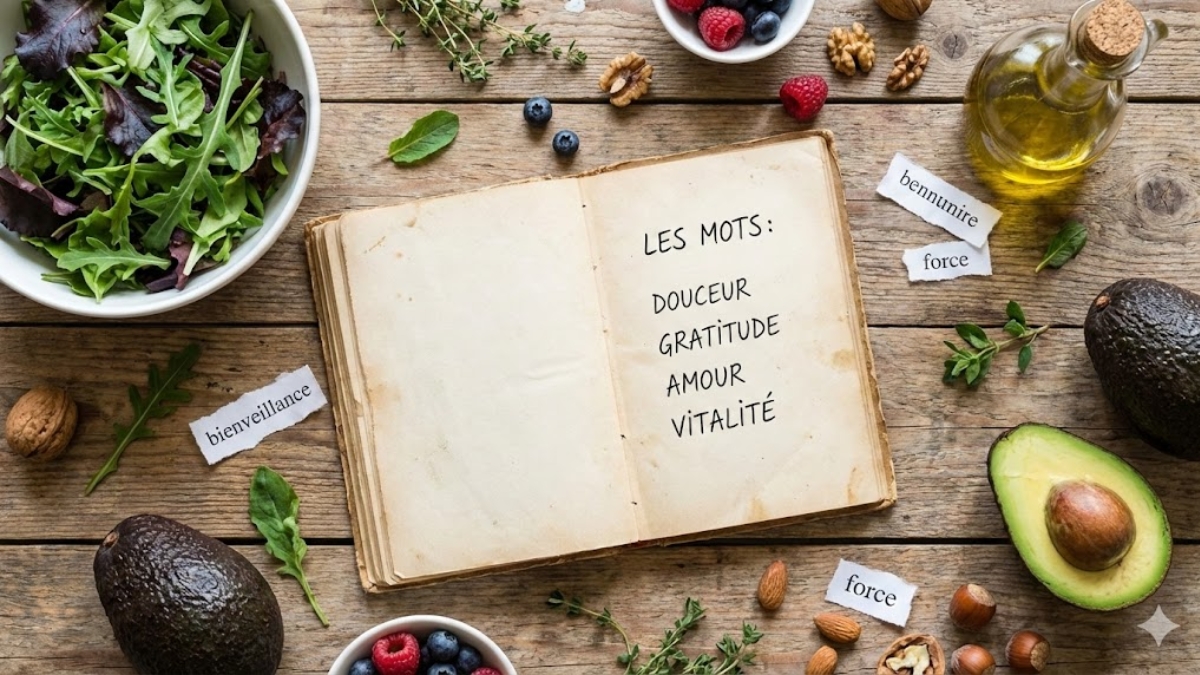
Food as Word: When Speech Becomes Nutrition
Japanese researcher Masaru Emoto ran a striking experiment: projecting words of love onto water produced harmonious, geometric, sublime crystal structures. Projecting anger produced chaotic, fragmented structures. The scientific rigour of this work is debated — but the beauty of the intention is unquestionable. And, crucially, the placebo and nocebo effects are solidly documented by medicine. What we believe and what we say measurably alters our biology.
Gratitude acts as a vibratory enzyme. Studies show that practising gratitude before a meal stimulates the vagus nerve, activates the parasympathetic system ("rest and digest"), increases digestive enzyme production and reduces inflammatory markers. Gratitude isn't politeness — it is a physiological prescription.
And every culture knew it. Christian grace: giving thanks before the meal. The Japanese Itadakimasu (頂きます): literally "I humbly receive" — an act of recognition for all beings and processes that made this meal possible. The yogic mantra before meals: "Brahmarpanam brahma havir..." — the offering is Brahman, the fire is Brahman. The Islamic Basmala: "Bismillah" before every act of eating. These traditions aren't superstitions — they are consciousness technologies that activate the parasympathetic state optimal for digestion.
The Vibration of Words — Bovis Scale
Vibratory Scale of Food Language
Unités Bovis (UB)
L'échelle de Bovis mesure la vitalité énergétique d'un aliment — plus le chiffre est élevé, plus l'aliment soutient la vitalité du corps. Indicatif, pas dogmatique.
Deprivation, guilt, cortisol ↑, inflammation, digestive contraction
Control, vigilance, moderate stress, HPA axis on alert
Vague intention, neither positive nor negative, neutral
Presence, autonomy, parasympathetic activated
Gratitude, oxytocin ↑, cardiac coherence, optimal digestive enzymes
Sacredness, total body-mind coherence, digestive flow state
The vibration of a sentence determines the biochemical state in which the body receives food. Same plate, different vibration, different digestion.
Three Ways of Speaking about Your Eating
Food Language: From Chaos to Ceremony
Language & Nutrition
Toxic language
Vocabulary of deprivation, guilt and war against oneself. Each word is a micro-aggression against the body.
Exemples
"I caved", "it's cheating", "I'm useless", "it's forbidden"
Effets
Chronic cortisol, inflammation, compromised digestion, toxic relationship with food
Functional language
Informative vocabulary, no emotional charge. Neither war nor poetry — the meal is a utilitarian act.
Exemples
"I eat balanced", "it's good for health", "I hit my macros"
Effets
Moderate stress, decent digestion, neutral but desacralised relationship
Ceremonial language
We speak of choice, gratitude, encounter with the living. The meal becomes a ceremony of consciousness and connection.
Exemples
"I celebrate this meal", "my body receives with gratitude", "I nourish life within me"
Effets
Parasympathetic dominant, cardiac coherence, optimal enzymes, maximum absorption
The same meal, received through three different states of consciousness, produces three different biochemistries. The plate hasn't changed — only the word has changed.
Five Initiatory Practices — The Laboratory of the Word
NLP without practice is a closed library. Here are five concrete, tested, living rituals — each under five minutes, each able to transform your day.
1. The Morning Thought Scan (2 minutes upon waking)
Before touching your phone, before the first coffee: close your eyes and observe the first three thoughts that arrive. Don't judge them — note them mentally. Are they seeds of vitality or weights? This simple observation creates space between you and your programs. Space is freedom.
2. The Alchemical Reformulation (throughout the day)
Choose three sentences you say regularly and transform them. "I'm tired" becomes "My body is inviting me to rest and regenerate". "I don't have time to cook" becomes "I choose to devote time to what truly nourishes me". "Organic is too expensive" becomes "I am investing in the quality of my cells".
This isn't denial — it is applied NLP reframing. You aren't denying reality; you are choosing a frame that opens possibilities instead of closing them.
3. The Gratitude Ritual Before Every Meal (5 seconds)
One sentence. Not a monologue. Just one sincere sentence, eyes on your plate: "Thank you for this living food that will nourish every one of my cells." Or simply: "Thank you." These five seconds activate the parasympathetic and turn a mechanical act into a moment of presence. It is the most extraordinary quality-to-time ratio there is.
4. The Consciousness Journal (evening, 2 minutes)
Every evening, note: one word that nourished you today (a compliment received, an intention set, a successful reframe) and one word that drained you (self-criticism, judgement, automatic complaint). This journal creates awareness of your linguistic patterns. And what becomes conscious can be transformed.
5. Post-Meal Silence Meditation (5 minutes)
After the meal, instead of standing up immediately or looking at a screen: five minutes of silence. Observe what is happening in the body. Observe the thoughts emerging. This practice develops interoception — the capacity to listen to the subtle signals of the body. And a body that is listened to is a body that heals.
Resources to Go Further
If this article has awakened something in you, here are four doors to go deeper:
"Words Are Windows (or They're Walls)" by Marshall Rosenberg — the bible of Nonviolent Communication. Rosenberg shows that our way of speaking creates connection or separation. Applicable to every shared meal, to every word laid on another's plate.
"As a Man Thinketh" by James Allen — a short, powerful classic, written in 1903. It states the founding principle: our thoughts shape our body as much as our food. A century before neuroscience, Allen had understood.
"The Structure of Magic" by Bandler & Grinder — the founding book of NLP. Dense but revolutionary. For those who want to understand the deep mechanisms of language on perception.
And finally, the video lectures of Marshall Rosenberg on NVC — available on YouTube, often subtitled. An hour with this man can transform the way you speak to yourself and to others. Forever.
Feeding the Brain That Feeds the Words
Inner language also depends on brain chemistry. It is hard to formulate luminous thoughts when the brain is lacking serotonin. Two powerful plant allies can support this alchemy:
Griffonia simplicifolia is the plant source most concentrated in 5-HTP, a direct precursor of serotonin — the neurotransmitter of serenity, satiety and well-being. A serotonin-rich brain produces a calmer, more kindly, more creative inner language. Biochemistry nourishes the word.
Composés actifs
Raw cacao contains anandamide, literally the "bliss molecule" in Sanskrit. Combined with theobromine (gentle energy without crash) and magnesium (muscular and nervous relaxation), raw cacao creates a state of openness and mental clarity ideal for an elevated inner language.
Composés actifs
The First Bite Always Happens in the Silence
Feeding the body without feeding the inner word is watering a garden whose seeds you are trampling. Words are the first soil in which every food takes root.
You don't need to change your plate tonight. Change a single sentence. Observe what happens in your body when the word "deprivation" becomes "elevation". When "diet" becomes "ritual". When "I have to" becomes "I choose to". The first bite always happens in the silence of your thoughts — that is where real nutrition begins.
Going deeper — the spiritual angle
This article treats NLP applied to nutrition. Its spiritual companion — NLP as a practice of consciousness, and why it echoes what traditions already knew — is published on our sister site: The Structure of Magic — when language becomes spiritual practice. The exploration there is conducted from the angle of Bandler, Grinder, Erickson, Tony Robbins, and the connection to sacred traditions of the creative word.
“Words are windows, or they are walls.”
Écrit par
Virgile
Chef & Chercheur en nutrition végétale
20 ans de recherche. Chef résident Maison ilā (The Times Top 50 World Spas). Fondateur levegetalien.fr. Je formule des aliments qui transforment ce que nous ressentons et pensons.
Receive the Notebook
A weekly letter — one ingredient, one protocol, one find.
Related articles
Sattva, Rajas, Tamas — Comment l'Alimentation Sculpte Notre Intériorité
Et si nos états intérieurs — l'agitation, la lourdeur, la clarté — n'étaient pas des hasards de l'humeur, mais le reflet direct de ce que nous mangeons ? Voyage dans les trois gunas, et dans cette vérité gênante : une alimentation trop excitante peut nous rendre sourds à notre propre dedans.
Pourquoi Être Végétalien — Le Corps, le Cœur et la Terre ont déjà répondu
Allons chercher de la nuance et de la clarté dans un sujet qu'on a rendu inutilement complexe.
Full Power — Comprendre l'Énergie du Corps
Et si l'énergie que nous ressentons — notre clarté, notre feu, notre paix — n'était pas un don du hasard, mais le résultat direct de ce que nous donnons à nos cellules ?